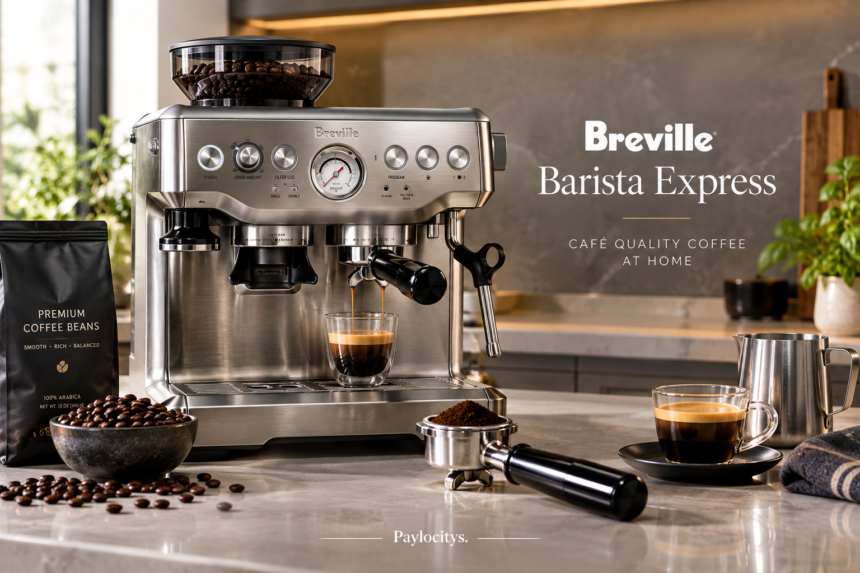
The Breville Barista Express is an all-in-one espresso machine designed for people who want more control than a pod system without buying a separate grinder. The BES870 combines a steel conical burr grinder, 54mm portafilter, espresso brewing system and manual steam wand in one countertop machine. It is aimed at home users who want to grind fresh beans, dial in a shot and learn the basic workflow of espresso making.
For buyers comparing home coffee machines, the appeal is straightforward: fewer separate components, hands-on control and a familiar café-style process.
What makes the Breville Barista Express different?
The biggest feature is the integrated grinder. Breville says the machine uses a precision conical burr grinder with 16 grind settings on its current US specification, with automatic dosing into the portafilter. That means you can go from whole beans to espresso without needing a separate grinder.
The brewing side uses a 54mm stainless-steel portafilter and supports single- and double-shot preparation. Breville also specifies low-pressure pre-infusion followed by extraction at 9 bar, powered by a 15-bar Italian pump. The distinction matters: the 15-bar figure describes the pump’s capability, while the machine’s stated extraction process uses 9 bar pressure.
Temperature control is another central feature. The Thermocoil heating system uses PID temperature control, while Breville states a target water temperature of 200°F on its US product page. This is designed to keep brewing temperature controlled rather than leaving the result entirely to the heating cycle.
Key specifications at a glance
| Feature | Breville Barista Express |
|---|---|
| Model | BES870 |
| Grinder | Steel conical burr |
| Grind settings | 16 |
| Portafilter | 54mm stainless steel |
| Pump | 15-bar Italian pump |
| Extraction | Low-pressure pre-infusion, 9-bar extraction |
| Water tank | 67 oz / 2 L |
| Bean hopper | 1/2 lb / about 227 g |
| Heating | Thermocoil with PID control |
| Milk system | Manual steam wand |
| US power | 1600W, 110–120V |
Specifications can vary by regional version. For example, Breville’s Australian listing gives a 250g hopper, 2L tank and 1850W power rating for the 220–240V version. Check the local product page before buying, particularly if you are purchasing in the UK or another market outside the US.
How the espresso-making process works
Using the Breville Barista Express is more involved than pressing a button on a fully automatic machine, but that is part of its purpose. You start by selecting fresh beans and choosing a grinder setting. The integrated grinder doses the coffee into the portafilter, after which you distribute and tamp the grounds.
Next, lock the portafilter into the group head and start the shot. The pressure gauge provides visual feedback during extraction, giving you another way to judge whether your preparation is in the expected range. If the shot runs too quickly or too slowly, adjusting the grind is one of the main ways to change the result.
Milk drinks require another step. The manual steam wand lets you heat and texture milk yourself, creating microfoam for drinks such as lattes and cappuccinos. This requires practice, but it also gives you more direct control than an automatic milk system.
💡 Pro Tip: Change one variable at a time when dialing in espresso. If you alter the grind, dose and tamping pressure simultaneously, it becomes difficult to tell which change improved or hurt the extraction.
Is the Breville Barista Express good for beginners?
The Breville Barista Express can suit beginners who want to learn espresso rather than simply automate it. The built-in grinder removes the need to select a separate grinder at the start, while the pressure gauge and manual controls make the brewing process visible.
There is still a learning curve. Grind size, dose, tamping, coffee freshness and extraction time all affect the cup. Milk texturing also takes practice. Someone who wants one-touch coffee with minimal preparation may prefer a more automated machine.
What are the main limitations?
The integrated design is convenient, but it also means the grinder and espresso machine are tied together. If you eventually decide to upgrade to a separate grinder, you may change the workflow rather than simply replacing one component.
The machine also requires manual milk steaming and puck preparation. Counter space is another consideration: Breville lists US dimensions of 12.5 inches wide, 13.8 inches deep and 15.9 inches high. It weighs about 22.1 pounds according to the US specification.
Regional electrical specifications matter too. The US model is listed at 110–120V, while Breville’s Australian version is 220–240V. Buyers should use the version intended for their market rather than assuming espresso machines are interchangeable across electrical systems.
What should you look for before buying?
Consider how much control you actually want. If you enjoy adjusting coffee variables and learning barista technique, the Breville Barista Express offers the necessary controls in a single machine. If convenience is the priority, its manual workflow may feel like extra work.
Also consider the coffee you normally drink. Espresso-focused users can take advantage of the grinder, portafilter and extraction controls, while people who mainly want large, simple cups of coffee may not use all of those features.
Maintenance also matters. The machine includes cleaning accessories and a water-filter setup, while regular cleaning of the group area, portafilter and steam wand helps maintain performance and hygiene.
📌 Key Takeaway: The Breville Barista Express combines grinding, espresso brewing and manual milk texturing in one machine. Its strongest appeal is control: you can learn the complete espresso workflow without buying a separate grinder. That same hands-on design means it takes more effort than an automatic coffee maker.
Frequently Asked Questions
Is the Breville Barista Express fully automatic?
No. It automates the grinding and offers preset single- or double-shot controls, but the user still needs to tamp the coffee, manage extraction and manually texture milk.
Does the Breville Barista Express have a built-in grinder?
Yes. The machine includes a steel conical burr grinder with 16 grind settings on the current US specification. The grinder is designed to dose coffee directly into the portafilter.
What size portafilter does it use?
The Breville Barista Express uses a 54mm stainless-steel portafilter. Breville specifies an 18g ideal dose for its espresso preparation.
Can it make lattes and cappuccinos?
Yes. Its manual steam wand is designed for milk texturing and microfoam, so it can be used for drinks such as lattes and cappuccinos. The user controls the steaming process.
How much water does it hold?
The US model has a 67-ounce water tank, equivalent to about 2 litres. Regional versions can have different electrical specifications, so check the local model before purchasing.
Conclusion
The Breville Barista Express remains a practical option for home users who want an integrated grinder and hands-on espresso workflow. Its combination of dosing, pressure feedback, PID temperature control and manual steaming gives beginners room to learn while keeping the setup relatively compact. Before buying, confirm the regional model, electrical rating and dimensions, then decide whether you want control or maximum automation from your coffee machine.