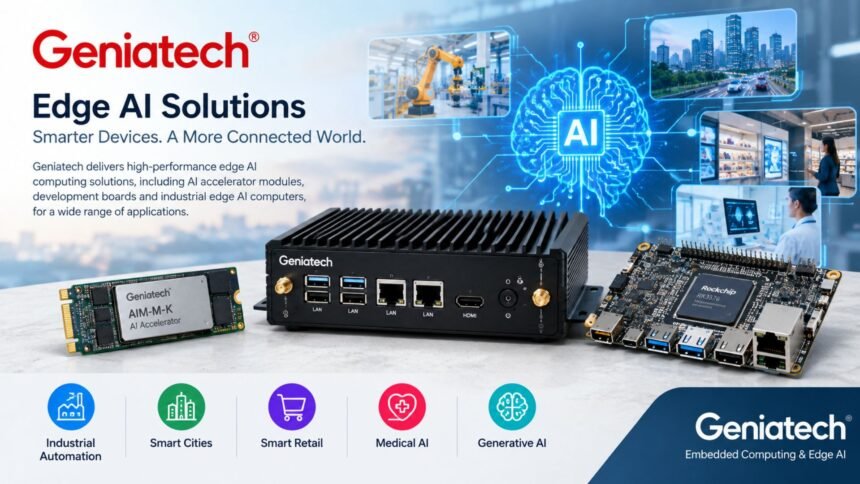
Geniatech Edge AI refers to a portfolio of hardware and computing platforms designed to run artificial intelligence workloads closer to where data is generated. Instead of sending every camera feed, sensor reading, or application request to a remote cloud server, these systems can process AI workloads locally or near the device. Geniatech positions its Edge AI portfolio around low-latency inference, flexible acceleration, embedded computing, and industrial deployment.
For businesses evaluating on-device AI, the appeal is straightforward: local processing can reduce network dependency, support faster responses, and provide greater control over sensitive data. The bigger question is which type of edge hardware fits a particular workload.
What Is Geniatech Edge AI?
Geniatech Edge AI is not a single computer or processor. It is an ecosystem covering AI accelerator modules, development boards, single-board computers, and complete edge AI systems. The company supports platforms built around processors and accelerators from vendors including NXP, Rockchip, Hailo, MemryX, DEEPX, and other AI technologies.
The portfolio ranges from compact M.2 accelerator cards to industrial edge computers. This modular approach allows developers to select computing power according to the application rather than building every system around a large cloud-connected server.
At the system level, Geniatech’s edge computers are designed for workloads such as machine vision, industrial automation, transportation, retail analytics, and IoT. Some models also support local large language model workloads, showing how edge computing is expanding beyond conventional computer vision.
How the Technology Works
Traditional cloud AI sends data to centralized infrastructure for processing. An edge AI architecture moves at least part of that computation closer to the source.
A camera installed in a factory, for example, can capture an image and send it to a nearby AI computer. The system performs inference locally and can trigger an action without waiting for a round trip to a distant data center.
| Area | Geniatech Edge AI Approach | Cloud AI Approach |
|---|---|---|
| Processing location | Device or nearby edge system | Centralized cloud infrastructure |
| Response time | Designed for low-latency inference | Depends partly on network conditions |
| Connectivity | Can reduce dependence on constant cloud access | Usually requires reliable connectivity |
| AI acceleration | NPU and dedicated accelerator options | Large centralized GPU/AI infrastructure |
| Deployment | Embedded, industrial, and IoT environments | Centralized applications and services |
| Data handling | Local processing can limit data transmission | Data may need to travel to cloud servers |
The distinction does not mean edge computing eliminates the cloud. In many deployments, edge and cloud systems work together: local hardware handles time-sensitive inference while centralized infrastructure manages analytics, storage, model development, or fleet-wide monitoring.
Key Hardware Options
Geniatech’s product range gives developers several ways to add AI capability.
AI Accelerator Modules
M.2 accelerator modules can add dedicated inference capability to compatible embedded systems. Geniatech currently lists products using technologies such as NXP Ara-240, Hailo-8, Hailo-10, MemryX MX3, DEEPX, and Rockchip-based acceleration.
This modular design can be useful when an existing embedded platform needs additional AI performance without replacing the entire computing architecture.
AI Development Boards
Development boards provide a practical environment for testing applications before committing to a production design. Geniatech lists boards based on processors such as Rockchip RK3576 and RK3588, along with NXP i.MX platforms.
Developers can use these platforms to evaluate interfaces, AI workloads, peripherals, and software before moving toward a customized product.
Industrial Edge Computers
For production deployments, industrial computers provide a more complete solution. Models in Geniatech’s portfolio include the APC880, APC880 Mini, APC880E, APC3576, APC3588, APC3588-AI, and newer APC885 platforms.
Some systems are designed with fanless operation, extended temperature support, multiple networking interfaces, and expansion options. Those characteristics matter in factories, transportation environments, retail installations, and other locations where conventional desktop hardware may not be appropriate.
💡 Pro Tip:
Choose the AI accelerator based on the model and inference framework you actually plan to deploy, not simply its headline TOPS figure. Software compatibility, memory, thermal limits, camera interfaces, and supported frameworks can have a greater practical effect on performance.
Where Geniatech Edge AI Fits Best
The strongest use cases are applications where data needs to be interpreted quickly and sending everything to the cloud is inefficient.
Industrial automation can use local vision systems to inspect products, monitor machinery, or identify events. Processing near the equipment can help reduce response delays.
Smart retail can combine cameras, displays, and local computing for analytics and intelligent customer-facing systems. Geniatech identifies smart retail as one of the industries supported by its broader edge computing portfolio.
Intelligent transportation is another natural application. Local systems can analyze traffic cameras and other sensor inputs without depending entirely on remote processing. Geniatech describes traffic-management solutions involving multiple IP cameras and AI-assisted analysis.
IoT deployments can also benefit when devices operate in locations with limited connectivity. Local inference can reduce the amount of raw sensor or video data that must be transmitted.
Edge LLM applications are becoming another area of interest. Geniatech promotes on-premise edge AI platforms capable of supporting local large language model workloads, particularly where organizations want AI processing closer to their own infrastructure.
Advantages and Limitations
The main advantage of Geniatech Edge AI is flexibility. Businesses can choose from modules, boards, or complete computers depending on how mature the project is.
Local inference can also reduce latency and bandwidth requirements. For privacy-sensitive applications, keeping processing near the source may reduce the amount of raw information that has to leave a facility.
However, edge hardware has limits. A compact embedded system cannot simply replace the computational capacity of a large cloud data center for every AI workload. Developers also need to consider thermal management, memory capacity, accelerator compatibility, model optimization, operating-system support, and long-term hardware availability.
That makes workload planning essential. A small vision model with strict response-time requirements may be an excellent edge application, while training a large foundation model remains better suited to powerful centralized infrastructure.
📌 Key Takeaway:
Geniatech Edge AI is best viewed as a scalable hardware ecosystem rather than one product. Its value comes from combining ARM-based embedded computing with dedicated AI acceleration for applications that benefit from local inference.
Frequently Asked Questions
What is Geniatech Edge AI used for?
Geniatech Edge AI is designed for local or near-device AI inference across embedded and industrial applications. Typical use cases include machine vision, industrial automation, smart retail, intelligent transportation, IoT, digital signage, and selected generative AI or local LLM workloads.
Does Geniatech Edge AI require cloud computing?
Not necessarily. Edge systems can perform AI inference locally, reducing dependence on continuous cloud connectivity. However, a hybrid architecture can still use cloud infrastructure for model training, centralized analytics, storage, device management, or other workloads that benefit from centralized resources.
Which AI accelerators does Geniatech support?
Geniatech’s current portfolio includes accelerator options based on technologies from NXP, Hailo, MemryX, DEEPX, and Rockchip, among others. Specific support depends on the particular board, computer, or accelerator module and its software environment.
Is Geniatech Edge AI suitable for industrial environments?
Several Geniatech systems are specifically positioned for industrial use. Selected products offer features such as fanless designs, extended operating-temperature ranges, industrial connectivity, and long-term deployment considerations. The appropriate model still depends on environmental and application requirements.
How should businesses choose an edge AI system?
Start with the workload rather than the hardware specification. Identify the AI model, required inference speed, cameras or sensors, memory needs, connectivity, operating environment, power limits, and software framework. Then compare accelerator support and expansion options to select a platform that can remain viable throughout the expected deployment period.
Final Thoughts
Geniatech Edge AI occupies an increasingly practical part of the AI hardware market: computing that brings inference closer to cameras, machines, sensors, and users. Its combination of AI accelerator modules, development platforms, and industrial computers gives developers multiple routes from experimentation to deployment.
For organizations building real-time embedded applications, the strongest reason to consider this approach is not simply AI performance. It is the combination of local processing, flexible hardware architecture, connectivity options, and deployment-oriented design. The right platform will depend on the model, environment, and workload—but for many industrial and IoT applications, putting AI closer to the data source can be a practical architectural advantage.