The Claude AI API gives developers a way to integrate Anthropic’s Claude models into websites, software, automation workflows, and business applications. Instead of using Claude only through a conversational interface, developers can send requests programmatically and receive model-generated responses inside their own applications.
The API supports tasks including text generation, analysis, coding, summarization, extraction, translation, and image understanding. Anthropic provides an API, SDKs, developer tools, and documentation designed for applications ranging from small experiments to larger production systems.
What Is the Claude AI API?
The Claude AI API is Anthropic’s developer interface for communicating with Claude models through software. A typical integration sends instructions and user-provided content to a selected model, then receives a structured response that the application can process or display.
This makes Claude useful when AI needs to become part of an existing workflow rather than remain a standalone chat experience.
For example, a company could build an application that uses Claude to summarize customer messages, analyze documents, generate programming assistance, classify text, or create draft responses. The application controls the surrounding experience while Claude handles the language and reasoning task.
How the API Works
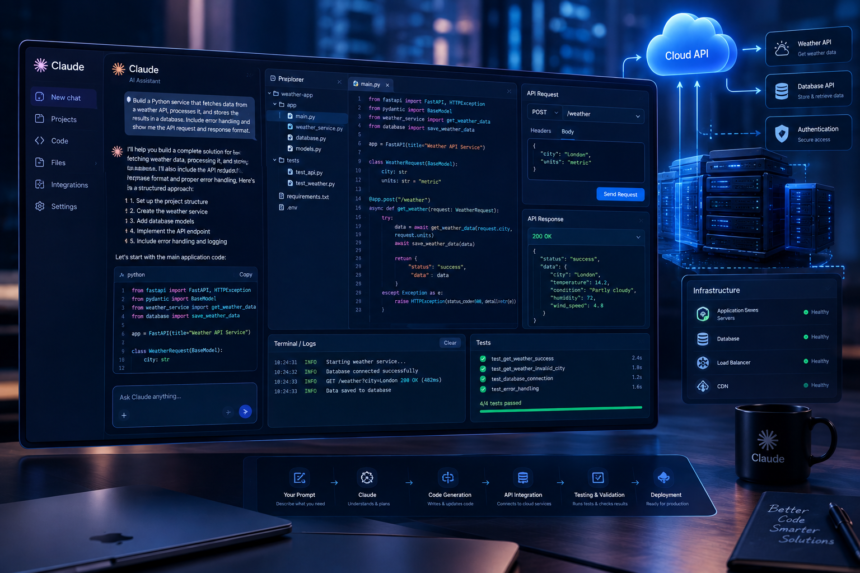
A basic integration follows a straightforward sequence:
- Create an Anthropic developer account and API credentials.
- Select an appropriate Claude model.
- Install an official SDK or make API requests directly.
- Send a request containing the relevant instructions and content.
- Receive the response and process it inside the application.
Anthropic provides SDK support and an API reference for developers who want to implement and scale integrations. Its documentation also provides a Console and Workbench for experimenting with prompts before building an application.
The important architectural decision is not simply connecting an API key. Developers need to decide how prompts, conversation history, errors, authentication, rate limits, logging, and model changes will be handled.
Claude Models and Choosing the Right One
Claude is offered through multiple model families with different capabilities, costs, and performance characteristics. The appropriate choice depends on the workload rather than simply selecting the most capable model available.
A complex reasoning or coding workflow may justify a more capable model, while high-volume classification or simpler generation may benefit from a faster, less expensive option.
Anthropic’s documentation also shows why model lifecycle management matters. Models can move from active to deprecated and eventually retired, requiring applications to migrate to recommended replacements.
| Consideration | What to evaluate | Why it matters |
|---|---|---|
| Capability | Reasoning, coding and analysis requirements | Determines suitable model class |
| Cost | Input and output token rates | Controls operating expenses |
| Latency | Response-time requirements | Affects user experience |
| Context | Size of prompts and documents | Determines how much information fits |
| Lifecycle | Active or deprecated status | Reduces migration problems |
| Volume | Number of requests | Influences architecture and budget |
For production applications, developers should test candidate models with representative workloads instead of relying only on general model descriptions.
Claude AI API Pricing
API usage is generally based on tokens processed by the model. Anthropic’s pricing documentation separates input tokens, output tokens, prompt-cache operations, and certain other features.
Pricing can vary substantially between models. Anthropic’s published pricing also describes prompt caching, which can reduce the cost of repeatedly processing the same context, and Batch API processing, which provides a 50% discount on eligible input and output processing compared with standard rates.
That means developers should estimate more than the price of a single request. A realistic budget should consider:
- Average input size
- Average output size
- Requests per user
- Peak traffic
- Cached content
- Batch workloads
- Model selection
💡 Pro Tip: Measure actual token consumption during development before setting a production budget. A short prompt can become expensive at scale if your application repeatedly sends large conversation histories, documents, tool definitions, or system instructions.
What Can Developers Build?
The Claude AI API can support a broad range of applications.
A content platform might use it for summarization, classification, editing assistance, or structured content generation. A customer-service application could analyze incoming messages and prepare suggested replies. Software products can incorporate coding assistance, document analysis, research workflows, or natural-language interfaces.
Anthropic also documents vision capabilities, allowing Claude to process images alongside text. Its platform materials describe tasks involving text, code, and images.
For larger systems, developers can combine model responses with application databases, search systems, authentication, business rules, and external tools. The model becomes one component of a broader software architecture rather than the entire application.
API Security and Production Considerations
An API key should be treated as a secret credential. It should not be exposed in browser-side JavaScript, public repositories, or client applications where users can retrieve it.
A safer architecture normally places API calls behind a server or controlled backend. The backend can authenticate users, validate requests, enforce usage limits, protect credentials, and monitor costs.
Developers should also think about sensitive information. Applications that send customer records, internal documents, or other confidential material need appropriate data-handling policies and technical controls.
Reliability deserves attention as well. Production applications should account for failed requests, timeouts, rate limits, malformed responses, and service interruptions rather than assuming every request will succeed.
Managing Long Context and Repeated Prompts
Large language applications can send substantial amounts of information to a model. Anthropic provides prompt caching features designed for situations where the same context is repeatedly processed. Its pricing documentation explains separate cache-write and cache-read rates.
Long-context workloads require particular care because larger inputs can increase both processing requirements and costs. Developers should avoid sending unnecessary information simply because the model can technically accept it.
A better architecture retrieves the most relevant information and supplies only what the model needs for the current task.
Keeping an Integration Current
An API integration is not a set-and-forget project. Model families change, older versions can be deprecated, and APIs may introduce new capabilities or requirements.
Anthropic recommends monitoring model lifecycle information and migrating applications before retirement dates. Its documentation specifically advises developers to test replacement models well before migration deadlines.
This is especially important for applications where consistent output matters. Before switching models, teams should test representative prompts, evaluate accuracy, measure latency and costs, and check whether output formatting has changed.
📌 Key Takeaway: The Claude AI API provides a practical way to embed Anthropic’s models into custom software, but successful implementation involves more than sending a prompt. Model selection, token costs, security, context management, error handling, and lifecycle planning all matter when moving from an experiment to production.
Frequently Asked Questions
Is the Claude AI API free?
API usage is generally billed according to usage and model pricing. Anthropic’s documentation notes that new users may receive a small amount of free credits for testing, while ongoing API usage is billed based on actual consumption.
What programming languages can use the Claude API?
Developers can use Anthropic’s SDKs or make direct HTTP requests. Anthropic provides developer resources and API documentation for building integrations across common programming environments.
Can Claude analyze images through the API?
Yes. Anthropic documents vision capabilities that allow Claude to process visual input and generate text or code based on images.
How is Claude API usage priced?
Pricing depends on the model and the number of input and output tokens processed. Additional mechanisms, including prompt caching and batch processing, can change the effective cost of workloads.
Do Claude API models change over time?
Yes. Anthropic maintains a model lifecycle in which models can become deprecated and later retired. Developers should monitor documentation and migrate applications to supported replacements when required.
Conclusion
The Claude AI API gives developers a flexible foundation for adding advanced language and reasoning capabilities to their own applications. Its usefulness extends from straightforward text generation to document analysis, coding workflows, image understanding, and more complex AI-powered systems.
The strongest implementations treat the API as part of a carefully designed software stack. Selecting the right model, controlling token usage, protecting credentials, testing outputs, and monitoring model changes can make the difference between a promising prototype and a dependable production application.
For developers researching the Claude AI API, the official documentation should remain the primary reference as models, pricing, features, and lifecycle policies evolve.